Jewelry Insurance Issues

FEBRUARY 2003

JEWELRY INSURANCE ISSUES (formerly IM News), provides monthly insight and information for jewelry insurance agents, underwriters and claims adjusters.

Subscribe to
Jewelry Insurance Issues

Table of Contents

Click on article titles in red

2010

Emeralds—And What They Include - January

Pink Diamonds: From Astronomical to Affordable - February

Palladium-the Other Precious White Metal - March

Bridal Jewelry - April

The Corundum Spectrum - May

How Photos Cut Fraud - and help the insured - June

The Price of Fad - July

Old Cut, New Cut-It's All about Diamonds - August

2009

Blue Diamond—cool, rare and expensive—sometimes - January

Turning Jewelry into Cash—
Strategy in a Bad Economy
- February

Enhancing the Stone - March

Being Certain about the Cert - April

Every Picture Tells a Story - May

Color-Grading Diamonds - June

The Newest Diamond Substitute - July

What Happens to Stolen Jewelry - August

Jewelry As an Investment - September

Black Diamond: Paradox of a Gem - October

Protect Your Homeowners Market—Keep Jewelry OFF HO Policies! - November

What’s So Great about JISO Appraisal Forms & Standards? - December

2008

Garnet—and Its Many Incarnations - January

Organic Gems - February

Do Your Jewelry Insurance Settlements Make You Look Bad? - March

Don't Be Duped by Fake JISO Appraisal - April

Diamonds in the Rough - May

The Cultured Club - June

Sapphire—Gem Superstar - July

It’s a Certified Diamond! 
— But who's saying so?
- August

FTC Decides: Culture Is In! - September

Paraiba Tourmaline – What's in a Name? - October

How Fancy is Brown? - November

CZ – The Great Pretender - December

2007

Moissanite's New Spin - January

Online Jewelry - Buying and Insuring - February

Blood Diamonds - March

Damaged Jewelry, Don't Assume!- April

Chocolate Pearls - May

Appraisal Puff-Up vs Useful Appraisal - June

It's Art, but is it Jewelry?
- July

Diamonds Wear Coats of Many Colors - August

DANGER! eBay Jewelry "Bargains" - September

TV Shopping for Jewelry - October

Enhanced Emerald: clever coverup - November

How do you like your rubies —
leaded or unleaded?
- December

2006

The New Platinum: A Story of Alloys - January

Ruby Ruse - February

How Big are Diamonds Anyway? - March

GIA Diamond Scandal
Has Silver Lining for Insurers
- April

Watch Out for Big-Box Retailers Insurance Appraisals - May

Mixing It Up: Natural and Synthetic Diamonds Together - June

Tanzanite - Warning: Fragile - July

Red Diamonds - August

Inflated Valuations & Questionable Certificates - September

Emeralds - October

Where Do Real Diamonds Come From? - November

Counterfeit Watches — The Mushroom War - December

2005

The Lure of Colored Diamonds - January

Synthetic Colored Diamonds - February

Watches: What to Watch for - March

When is a Pear not a Pair? - April

The Truth About Topaz - May

White Gold: How White is White? - June

One of a Kind — or Not - July

Jewelry in Disguise - August

Valued Contract for Jewelry? Proceed with Caution! - September

Antiques, Replicas and All Their Cousins
October

Grading the Color of Colored Diamonds
November

New GIA Cut Grade for Diamonds - December

2004

Synthetic Diamonds — and Insuring Tips - January

Bogus Appraisals and Fraud - February

A Picture is Worth Thousands of Dollars - March

Don't be Duped by Fracture Filling - April

Gem Scams Point to Need for Change - May

What is a Good Appraisal - June

4Cs of Color Gemstones - July

Gem Laser Drilling: The Next Generation - August

Why Update an Appraisal? - September

When to Recommend an Appraisal Update or a Second Appraisal - October

Secrets of Sapphire - November

Will the Real Ruby Please Stand Up - December

2003

Mysterious Orient:
A Tale of Loss
- January

Bogus Diamond Certificates and Appraisals - February
Can Valuations be Trusted? - March

Spotting a Bogus Appraisal or Certificate - April

Counterfeit Diamond Certificates - May

Case of the Mysterious "Rare" Sapphires - June

Politically Correct Diamonds - July

Name Brand Diamonds - September

Princess Cut: Black Sheep of Diamonds - October

Reincarnate as a Diamond - November

Synthetic Diamonds - December

2002

Irradiated Mail/Irradiated Gems - January

Fake Diamonds (Moissonite) - February

GIA Diamond Report - March

AGS and Other Diamond Certificates - April

Colored Stone Certificates - May

Damaged Jewelry: Don't Pay for Nature's Mistakes - June

The Case of the "Self-Healing" Emerald - July

Mysterious Disappearance: Case of the Missing Opals - August

The Discount Mirage - September

What Can You Learn from Salvage? - October

Gaining from Partial Loss - November

Year in Review - December

2001

Colored Diamonds - January

Good as Gold - February

Disclose Gem Treatments - March

FTC Jewelry Guidelines - April

Myths Part I: Each Piece is Unique - May

Myths Part II: Myths, Lies, & Half-Truths - June

New Trend: Old Cut Stones - October

The Appraisal Process - November

Year in Review - December

2000

Deceptive Pricing - January

Gems - Natural or Manmade - February

Jeweler/Appraisal Credentials - March

Fracture Filling - April

Salvage Jewelery - May

Gem Treatments - June

Don't Ask/Don't Tell - A Buying Nightmare - July

Laser Drilling of Diamonds - August

Jeweler Ethics or the Lack Thereof - September

Gem Scam - October

The Truth about Clarity Grading - November

Year in Review - December


We'll be glad to notify you when the Jewelry Insurance Issues is available each month. Sign up for your FREE SUBSCRIPTION to Jewelry Insurance Issues.

Visit the rest of the JCRS site:  www.jcrs.com

Bogus Diamond Certificates
and Appraisals

How can you tell a reliable diamond certificate from just another advertising tool?

“Certified diamonds” have a remarkable draw in jewelry sales. Consumers realize they have little expertise in judging diamonds, so they rely on paperwork to prove the value of what they are buying.

Retailers are offering this proof. Zales, a major jewelry chain, started certifying large diamonds five years ago. Because customers have come to expect certificates, the store NOW supplies them even for low-cost fashion items.

However, not all diamond certificates are reliable.

A reliable diamond certificate is a detailed description of the stone prepared by a respected independent laboratory, such as the Gemological Institute of America (GIA). Its purpose is to verify the quality of the diamond. A certificate from an independent lab does not carry valuation, since this isn’t the domain of the lab.

The new trend among large retailers is to supply documents that do carry valuation.

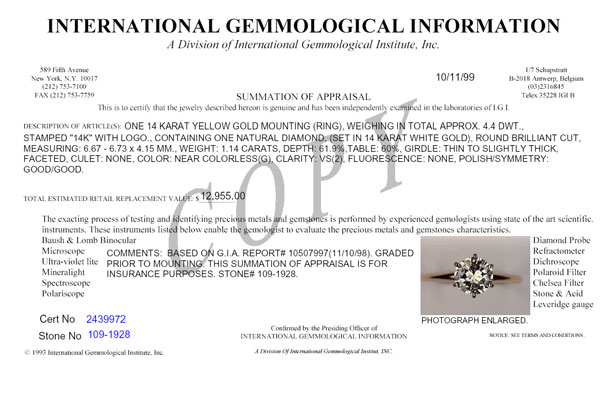
1. For example, Costco, the membership warehouse club, offers on its web site a 1.14 carat diamond ring that retails for $6,999.99. It comes with a “Summation of Appraisal” certificate placing its value at $12,955. (View description and certificate.)
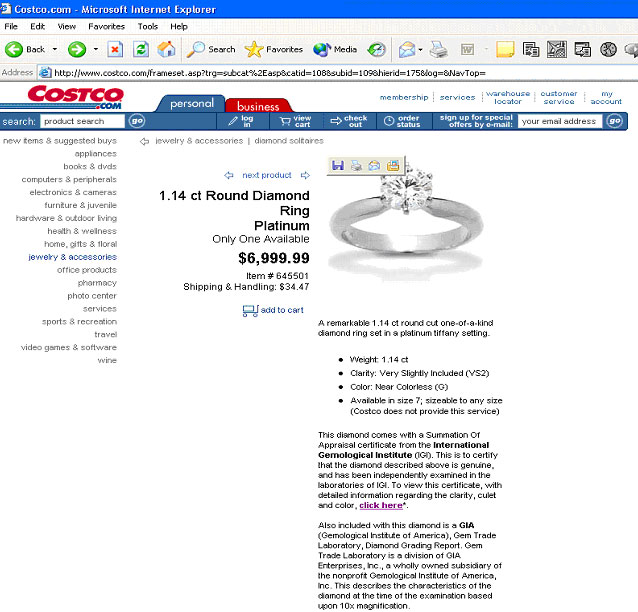
How can a buyer pass up such a bargain? The ring is worth twice its price and here’s a certificate to prove it!

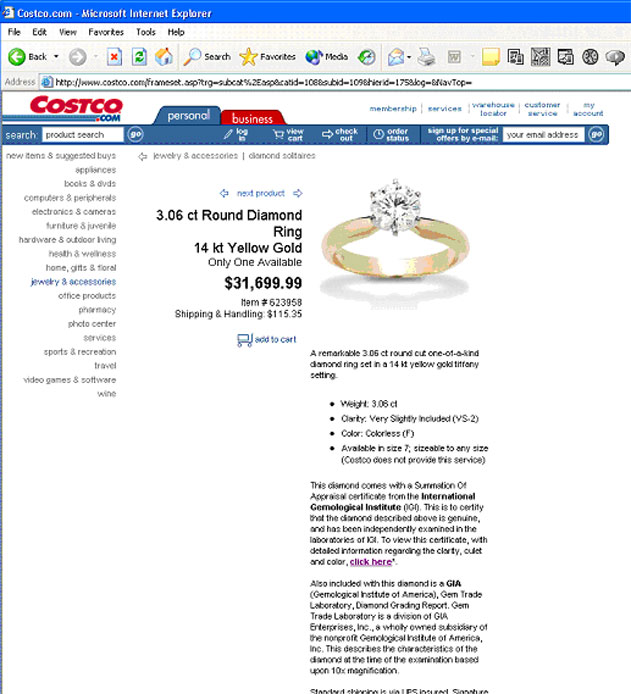
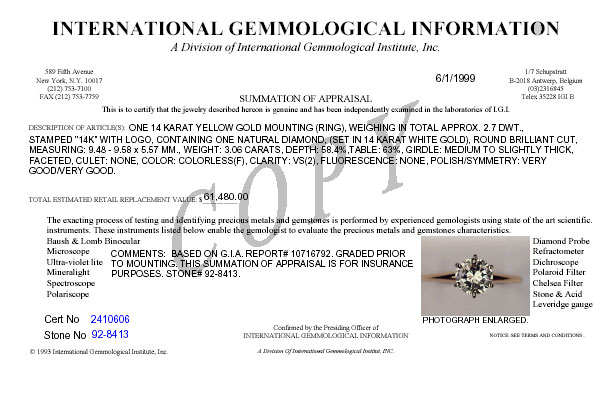
2. Another item for sale through Costco is a 3.06 carat diamond ring selling for $31,699.99, with a certificate valuing it at $61,480. (View description and certificate.)

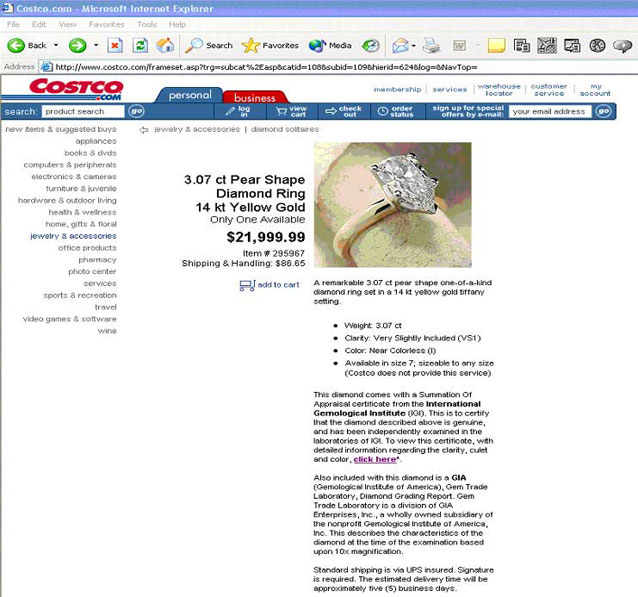
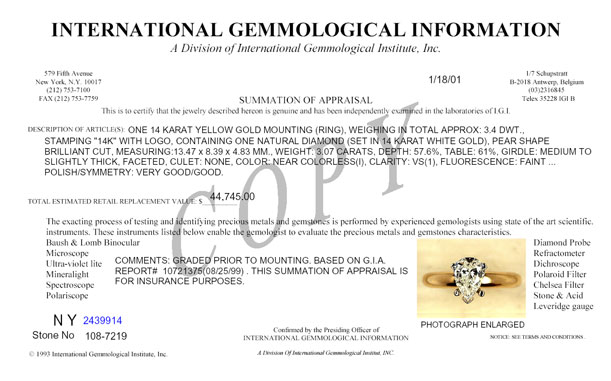
3. A 3.07 carat diamond ring from Costco selling for $21,999.99 comes with a valuation of $44,745. (View description and certificate.) These three examples are typical of the discrepancies between price and valuation.

What’s going on here? Can Costco afford to sell its jewelry at half the price of other retailers, simply because of its high volume? The answer is: No.

If you were to buy that $22,000 ring in a retail store in a small town in the Midwest, would you have to pay $44,745? Highly doubtful.

It is often argued that jewelry prices in, say, New York City are lower because there is more competition. However, in the Midwest rents and salaries are lower, so things pretty much balance out. And everyone is in competition with the Web. Jewelry is ultimately a national market, not a local one.

What’s going on here is a subtle scheme. Costco’s jewelry is, in fact, fairly priced. The valuations, however, are totally unrealistic.

Independent analyses of the stones’ qualities (as described on the Web site) show that the selling prices are quite competitive. These rings, if the quality is as described, are good deals.

The purpose of offering a certificate that places valuation at double the selling price is to lure consumers into making the purchase. The “Summation of Appraisal” comes from a lab with an official sounding name. It has a certificate number, a stone number, a photograph of the jewelry. Internet shoppers, especially, expect bargains, and this “Summation of Appraisal” acts as evidence they are getting a bargain.

The customer gets what he pays for, but here’s the danger for insurers. The document states: “This summation of appraisal is for insurance purposes.” If the insurer sees only this document and not the sales slip or an independent appraisal, the policy will be based on the inflated value rather than a realistic one.

FOR AGENTS & UNDERWRITING

Do not rely on diamond certificates that carry valuation, as these valuations are often inflated and the description may not be accurate. Ask to see the sales slip. Ask for a descriptive appraisal and valuation by a graduate gemologist who is a Certified Insurance Appraiser (CIA)™ and who has examined the stone.

Be attentive with jewelry from large retailers, especially when the purchase price is significantly below the certified valuation.

For large retailers, certificates and other appraisal documents are sales tools. You have no way of knowing whether a certificate supplied by a retailer represents the jewelry actually purchased. The same is true for online purchases. Ask for a descriptive appraisal on ACORD 78/79, prepared by a graduate gemologist who is a Certified Insurance Appraiser (CIA)™.

Even certificates from respected authorities such as GIA and AGS leave out information crucial to valuation, such as mounting data. For quality jewelry, always ask for a descriptive appraisal, preferably on ACORD 78/79.

FOR CLAIMS

If the insured item has only a certificate by a suspect lab, the valuation is probably inflated.

If the valuation on a certificate is much higher than the purchase price, the valuation is probably inflated.

In pricing a replacement, use descriptive information from the certificate or appraisal to get competitive bids. Don’t automatically turn to the seller for replacement.

NEXT ISSUE...

Can Valuations Be Trusted?

The limit of liability for jewelry is usually based on the valuation. Whose valuation are you trusting? How do bogus valuations play out for the insurer? What can you do about them?


©2010, JCRS Inland Marine Solutions, Inc. All Rights Reserved. www.jcrs.com

Subscribe to Jewelry Insurance Isssues

Sponsored by Jewelry Insurance Brokerage of North America

For Insurance professionals: Jewelry Insurance: The Underwriting and Claims Reference Manual is the essential reference tool enabling insurance professionals to better understand jewelry and jewelry insurance.

This valuable resource will help insurers at every level to more thoroughly and accurately submit, underwrite, and process jewelry insurance business. The information provided is especially helpful for identifying potential underwriting and claims issues as well as mitigating overpayment of claims settlements.